LAS MUSAS DE LA GUITARRA
RITRATTI FEMMINILI A
SEI CORDE
Francesco
Molmenti
CHITARRA
ANTONIO DE TORRES 1884
"Collezione Carlo
Alberto Carutti"
(Cremona, Museo Civico Ala Ponzone)
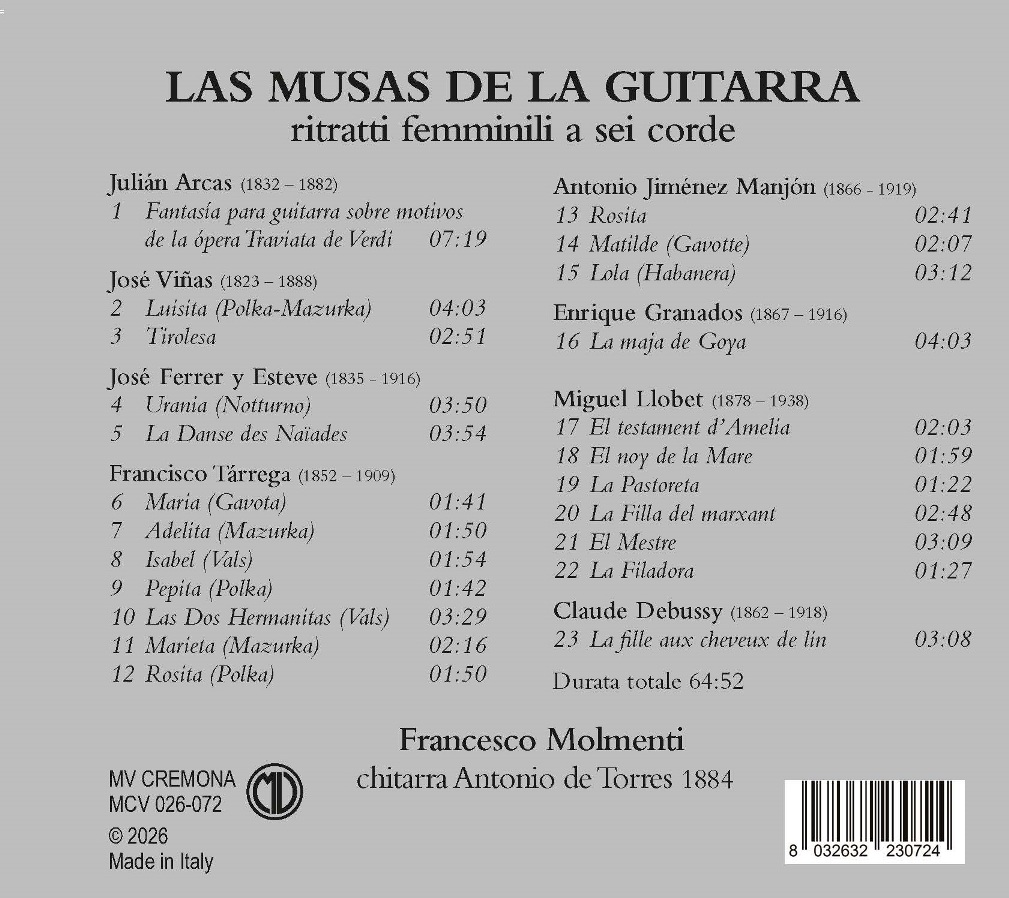
Format : 1 CD Total Time : 64'52"
Label : MV Cremona
Catalog No.: MVC026 072
EAN : 8032632230724
Publishing Year : 2026
Booklet: Italiano/English
Recorded at:
Museo Civico Ala Ponzone Cremona
"Sala Manfredini"
Luglio 2025
SOUND ENGINEERING &
DIGITAL EDITING
Simone Bellucci

Antonio de Torres Jurado (Almería,13 giugno 1817 – 19 novembre 1892)
Antonio de Torres rappresenta una figura centrale nella
storia della liuteria: il suo contributo fu determinante nel definire le
dimensioni, la forma, il progetto e la tecnica costruttiva della
chitarra classica moderna. Grazie al suo lavoro, lo strumento ha
assunto le caratteristiche che ancora oggi lo contraddistinguono. La
formazione di Torres si svolse, con molta probabilità, a Granada. Questo
periodo formativo coincise con la cosiddetta prima epoca della sua
attività, che si concluse nel 1869. In questi anni, il livello tecnico e
artistico raggiunto dal liutaio spagnolo fu particolarmente elevato,
confermandolo come uno dei più grandi costruttori del suo tempo.
Dopo una pausa di alcuni anni, Torres intraprese nel 1875 quella che
viene definita la seconda epoca della sua produzione. Questa fase, che
proseguì fino alla sua morte nel 1892, fu caratterizzata da un
equilibrio perfetto tra forma, proporzioni, peso e dimensioni, elementi
che hanno reso le sue chitarre modelli di riferimento per generazioni di
liutai. Le oltre cento chitarre note costruite da Torres vennero
ammirate e spesso imitate: nel corso degli anni, molti strumenti furono
attribuiti a lui, anche se si trattava di falsi, talvolta realizzati da
liutai rinomati ed esperti.
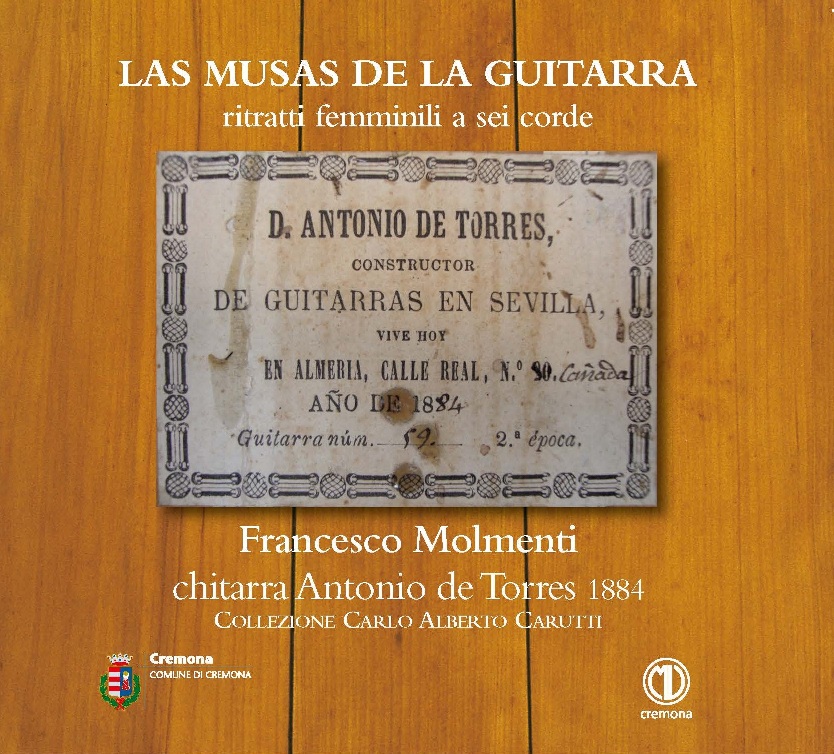
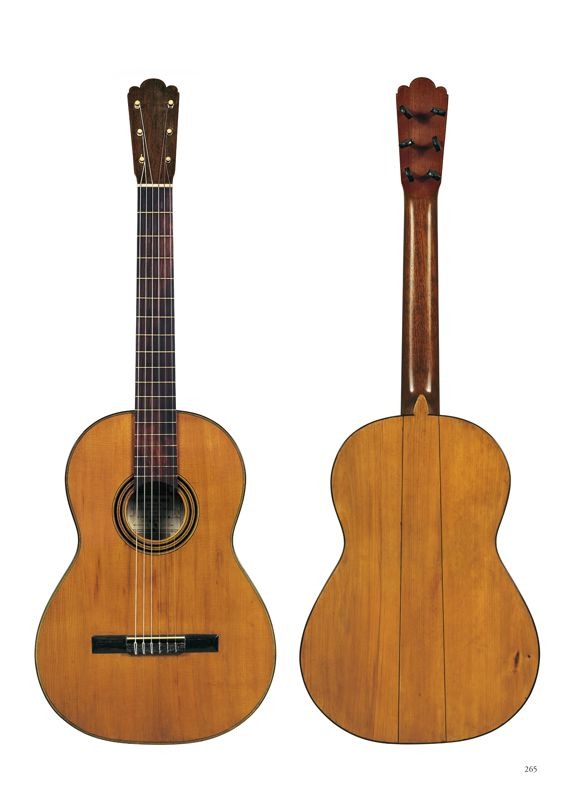
Un esempio rappresentativo dell’attività di Torres è la chitarra
conservata nella collezione Carlo Alberto Carutti. Costruita ad Almería,
lo strumento reca un cartiglio con la data 1884 e il numero progressivo
59, collocandosi nella “seconda epoca” creativa del liutaio:
caratterizzata dall’utilizzo di essenze lignee più economiche come
cipresso e mogano, che Torres alternava a materiali più pregiati quali
acero e palissandro brasiliano. destinati agli strumenti di fascia
superiore. Opzioni diverse che non influivano sulla resa sonora delle
chitarre del liutaio di Almeria.
(Fausto Cacciatori)
CHITARRA
ANTONIO DE TORRES 1884
"Collezione Carlo
Alberto Carutti"
(Cremona, Museo Civico Ala Ponzone)
Due elementi conferiscono coerenza e unità al programma
di questo disco. Innanzitutto, i brani scelti condividono la presenza
di un nome femminile nel titolo; inoltre, quasi tutti i compositori
sono di origine spagnola (eccezion fatta per Claude Debussy) e vissero
nell’epoca in cui Antonio de Torres (Almeria 1817-1892) realizzava le
sue chitarre. È noto che Julián Arcas, Francisco Tárrega, Miguel Llobe e
Antonio Jiménez Manjón suonarono strumenti costruiti da Torres. Degli
altri autori si conoscono meno dettagli biografici, ma l’estetica delle
loro opere si accorda perfettamente con il timbro e la sensibilità
della chitarra ottocentesca. Il programma include anche due composizioni
di autori non chitarristi:
La maja de Goya
di Enrique Granados e
La fille aux cheveux de lin
di Claude Debussy. Il primo, nella trascrizione di Llobet, si lega idealmente alla selezione di canzoni catalane; il
secondo, pensato come
bonus track,
è un omaggio poetico al compositore francese e al suo dialogo ideale con
la Spagna, mai visitata ma profondamente evocata, ad esempio, nel suo
La soirée dans Grenade.
Julian Arcas (María 1832 – Antequera 1882), celebre chitarrista spagnolo, fu tra i primi a esibirsi con le chitarre di Torres, incoraggiandone le innovazioni costruttive come l’incatenatura a raggera della tavola armonica. Nella Fantasía sobre motivos de la Traviata de Verdi, Arcas rielabora liberamente diversi temi dell’opera per delineare un ritratto complesso di Violetta Valéry. Il motivo musicale di Amami, Alfredo funge da introduzione e nucleo melodico, dapprima esposto con armonici delicati e poi sviluppato in arpeggi. Ai momenti lirici si alternano episodi vivaci dal ritmo di tarantella, che richiamano le scene festive dell’Atto I in contrasto con l’introspezione della protagonista. La seconda parte, basata su Addio del passato, ripercorre il travaglio emotivo di Violetta — dolore, nostalgia, speranza e disillusione — fino a intrecciarsi con A quell’amor ch’è palpito, per poi chiudersi con la celebre cabaletta Sempre libera. Arcas ripropone ancora una volta una contraddizione emotiva presente in Violetta: da una parte il desiderio di abbandonarsi all’amore per Alfredo e sperimentare il turbamento per una nuova condizione (essere amata amando!), dall’altra la necessità di seguire l’impulso vitalistico, scandaloso per quei tempi, espresso nel testo della celebre cabaletta con la quale si conclude questa fantasia.
José Viñas y Diaz (Barcellona 1823 – 1888), musicista poliedrico, fu violinista, pianista, cantante e direttore d’orchestra. I suoi brani Luisita (polka-mazurka) e La Tirolesa rivelano una piena padronanza delle risorse idiomatiche dello strumento e un gusto che ammicca alla musica di moda nell’area austro-tedesca.
Seguono due brani di
José Ferrer y Esteve de Pujadas (1835 - 1916),
chitarrista di discreta fama, soprattutto come didatta, attivo tra
Barcellona e Parigi: il notturno
Urania,
ispirato alla musa dell’astronomia, e
La Danse des Naïades,
una mazurka che evoca le ninfe delle acque dolci.
Francisco Tárrega
(Vilareal 1852 – Barcellona 1909) è il più noto tra i compositori in
programma. Questa antologia lo inserisce in un contesto ricco e vitale,
mostrando come la sua opera, pur distintiva, affondi le radici in un
ambiente musicale fecondo. Tárrega dedicò numerosi brani a familiari e
allieve:
Maria
alla
moglie Maria Josefa Rizo,
Marieta
alla
figlia Maria Rosalia; le polke
Rosita
e
Pepita
a due
discepole. La celebre
Adelita
potrebbe riferirsi a una studentessa (Adela Segarra
Ribes) o, più probabilmente, alla figlia di Adela Almerich Cardet,
amante del re Alfonso XII, che
Tárrega frequentava durante il suo soggiorno a Burriana (Valencia). Neanche nel caso di Las dos Hermanitas sappiamo a quali Due sorelline pensò Tarrega per la scrittura del suo valzer, e non è chiaro se il titolo alluda a un episodio biografico oppure a un elemento folkloristico. Il brano è chiaramente ispirato allo stile dei valzer chopiniani, come dimostra la citazione introduttiva del valzer op. 34 n. 1. Un’influenza straussiana sembra invece sottostare alla scrittura del valzer Isabel, ma anche in questo caso il riferimento personale resta oscuro.
Antonio Jiménez Manjón (Villacarrillo 1866 – Buenos Aires 1919), cieco fin dall’infanzia, intraprese una brillante carriera internazionale prima di stabilirsi in Argentina. Virtuoso della chitarra a undici corde, lasciò un catalogo ristretto ma significativo, tra cui Rosita, Lola (habanera) e Matilde (gavotta), tre ritratti femminili di tono intimo e raffinato.
La maja de Goya, nella trascrizione per chitarra sola di Miguel Llobet, nasce da una tonadilla di Enrique Granados (Lleida 1867 – La Manche 1916) per voce e pianoforte. L’identità della musa di Goya resta incerta — forse la duchessa d’Alba o Pepita Tudó — ma il testo, intonato dalla modella, celebra con ardore l’artista-amante, capace di un amore così intenso da rendere vana ogni altra aspirazione.
Miguel Llobet (Barcellona 1878 – 1938), tra i più raffinati chitarristi e compositori del primo Novecento, è noto per le sue trascrizioni delle Canzoni popolari catalane. Questi brani, originariamente cantati, conservano un ricco tessuto poetico che illumina le figure femminili evocate nei titoli. In El testament d’Amelia la protagonista, una giovane principessa avvelenata dalla madre, pronuncia prima di morire un testamento di dolore (in alcune versioni la maledice: “a te madre regalerò le mie scarpe con il tacco, così cadrai dalle scale e ti romperai l’osso del collo”). Dopo una madre tremenda, una madre esemplare: El noy de la Mare (il figlio della Madre) rievoca la dolce intimità di una ninna nanna mariana. La Pastoreta celebra la semplicità e l’innocenza della giovane pastorella, mentre La filla del marxant (La figlia del mercante), dietro un’apparente leggerezza, cela una storia tragica e moraleggiante: la giovane Elianor, sedotta da un amante, resta incinta e tenta invano di cancellare la propria colpa presso una fontana miracolosa. Trovandola secca, si dispera, partorisce e tenta di uccidere il neonato gettandolo in un fiume; tuttavia viene scoperta, imprigionata e condannata a morte. Prima dell’esecuzione ammonisce le ragazze a non ripetere i suoi errori. Nel brano El Mestre è una giovane a parlare: innamorata del proprio maestro, partito per la guerra, ne attende il ritorno con maliconia. Nell’orto paterno incontra un francolino posato su un arancio dai rami d’oro e dal tronco d’argento: l’uccello le chiede cosa darebbe per riavere il suo amato, e lei offre simbolicamente ricchezze immense, esprimendo la forza del suo amore e della sua fedeltà. Il francolino le dona infine una fontanella magica, segno di un nutrimento spirituale e di un legame che trascende la lontananza e la guerra. Nell’ultima canzone proposta, La Filadora, Maria, una giovane contadina catalana, nella notte di Natale decide finalmente di iniziare a filare. Nella stessa notte incontra il giovane che ama e insieme immaginano il loro futuro.
Chiude il programma la trascrizione per chitarra di La fille aux cheveux de lin (La ragazza dai capelli color del lino) di Claude Debussy (Saint-Germain-en-Laye 1862 – Parigi 1918), tratta dai Préludes (1910). Ispirata a una poesia di Leconte de Lisle, la composizione ritrae una figura femminile luminosa e pura, dai capelli dorati e labbra rosse come ciliegie, simbolo di un amore giovanile, sensuale e innocente.
(Francesco Molmenti)
Antonio de Torres Jurado (Almería, 13 June 1817 – 19 November 1892)
Antonio de Torres stands as a central figure in the history of guitar making. His contribution was crucial in defining the dimensions, shape, design, and construction technique of the modern classical guitar. Thanks to his work, the instrument acquired the features that still distinguish it today. Torres’ training most likely took place in Granada. This formative period coincided with what is known as the first era of his activity, which ended in 1869. During these years, the technical and artistic level achieved by the Spanish luthier was particularly high, confirming him as one of the greatest makers of his time. After a break of several years, Torres began in 1875 what is defined as the second era of his production. This phase, which continued until his death in 1892, was characterised by a perfect balance between shape, proportions, weight, and dimensions, elements that made his guitars models of reference for generations of luthiers. The more than one hundred known guitars built by Torres were admired and often imitated: over the years, many instruments were attributed to him, even if they were fakes, sometimes made by renowned and skilled luthiers. A representative example of Torres’ work is the guitar preserved in the Carlo Alberto Carutti collection. Built in Almería, the instrument features a label with the date 1884 and progressive number 59, placing it in the “second period” of the luthier’s creative activity. This era was characterised by the use of more economical woods such as cypress and mahogany, which Torres alternated with finer materials such as maple and Brazilian rosewood intended for top-end instruments. Different options that did not affect the sound quality of the guitars made by the Almería luthier.
(Fausto Cacciatori)
Las musas de la guitarra
Female Portraits in the Spanish Guitar of the 19th and
Early 20th Centuries
Two elements give coherence and unity to the programme of this recording. First, all the selected pieces share the presence of a female name in their title; moreover, almost all the composers are of Spanish origin (with the exception of Claude Debussy) and lived during the period in which Antonio de Torres (Almería, 1817–1892) built his guitars. It is known that Julián Arcas, Francisco Tárrega, Miguel Llobet, and Antonio Jiménez Manjón played instruments crafted by Torres. Of the other composers, fewer biographical details are known, but the aesthetics of their works perfectly match the timbre and sensitivity of the nineteenth-century guitar. The programme also includes two compositions by non-guitarist composers: La maja de Goya by Enrique Granados and La fille aux cheveux de lin by Claude Debussy. The former, in Miguel Llobet’s transcription, is ideally connected to the selection of Catalan songs; the latter, conceived as a “bonus track,” is a poetic homage to the French composer and to his ideal dialogue with Spain — a country he never visited, yet deeply evoked, as in La soirée dans Grenade.
Julián Arcas (María, 1832 – Antequera, 1882), a celebrated Spanish guitarist, was among the first to perform on Torres guitars, encouraging their structural innovations such as fan bracing of the soundboard. In the Fantasía sobre motivos de la Traviata de Verdi, Arcas freely reworks various themes from Verdi’s opera to portray a complex musical portrait of Violetta Valéry. The theme Amami, Alfredo serves as both introduction and melodic nucleus, first presented with delicate harmonics and then developed in arpeggios. Lyrical passages alternate with lively, tarantella-like episodes recalling the festive scenes of Act I, in contrast with the protagonist’s introspection. The second part, based on Addio del passato, retraces Violetta’s emotional turmoil — pain, nostalgia, hope, and disillusion — intertwined with A quell’amor ch’è palpito, and finally closing with the famous cabaletta Sempre libera. Once again, Arcas captures Violetta’s emotional contradiction: on the one hand, her desire to surrender to love and experience the thrill of being loved while loving; on the other, the vital and socially transgressive impulse expressed in the cabaletta that concludes this fantasy.
José Viñas y Díaz (Barcelona, 1823 – 1888), a versatile musician, was a violinist, pianist, singer, and conductor. His pieces Luisita (polka-mazurka) and La Tirolesa reveal a full command of the guitar’s idiomatic resources and a taste that nods toward the fashionable Austro-German musical style of the period.
Two pieces by José Ferrer y Esteve de Pujadas (1835 – 1916) follow. A guitarist of modest renown, known especially as a pedagogue, he was active between Barcelona and Paris. His Urania, a nocturne inspired by the muse of astronomy, and La Danse des Naïades, a mazurka evoking the nymphs of fresh waters, reflect a refined poetic imagination.
Francisco Tárrega (Vila-real, 1852 – Barcelona, 1909) is the most renowned of the composers featured in this anthology. This selection situates him within a rich and vibrant context, showing how his distinctive voice was rooted in a fertile musical environment. Tárrega dedicated numerous works to family members and pupils: Maria to his wife Maria Josefa Rizo, Marieta to his daughter Maria Rosalia; the polkas Rosita and Pepita to two of his students. The famous Adelita may refer to a pupil (Adela Segarra Ribes) or, more probably, to the daughter of Adela
Almerich Cardet — mistress of King Alfonso XII—whom Tárrega knew during his stay in Burriana (Valencia). In the case of Las dos Hermanitas, we do not know which “two little sisters” inspired the waltz, nor whether the title alludes to a biographical episode or a folkloric motif. The piece clearly draws on the style of Chopin’s waltzes, as shown by the introductory quotation from the Waltz Op. 34 No. 1. A more Straussian influence seems to underlie Isabel, though its personal reference likewise remains obscure.
Antonio Jiménez Manjón (Villacarrillo, 1866 – Buenos Aires, 1919), blind from childhood, enjoyed a brilliant international career before settling in Argentina. A virtuoso of the eleven-string guitar, he left a small but significant catalogue that includes Rosita, Lola (habanera), and Matilde (gavotte) —three intimate and refined female portraits.
La maja de Goya, in the solo guitar transcription by Miguel Llobet, derives from a tonadilla by Enrique Granados (Lleida, 1867 – La Manche, 1916) for voice and piano. The identity of Goya’s muse remains uncertain — perhaps the Duchess of Alba or Pepita Tudó — but in the song text, sung by the model, she ardently celebrates the artist-lover, whose passion renders every other aspiration vain.
Miguel Llobet (Barcelona, 1878 – 1938), one of the most refined guitarists and composers of the early twentieth century, is best known for his transcriptions of Catalan Folk Songs. These pieces, originally sung, retain a rich poetic fabric that illuminates the female figures evoked in their titles. In El testament d’Amelia, the protagonist, a young princess poisoned by her mother, utters a final testament of pain (in some versions she curses her: “To you, mother, I’ll give my heeled shoes, so you’ll fall on the stairs and break your neck”). El noy de la Mare (“The Mother’s Son”) recalls the tender intimacy of a Marian lullaby. La Pastoreta celebrates the simplicity and innocence of a young shepherdess, while La filla del marxant (“The Merchant’s Daughter”) hides, beneath its apparent lightness, a tragic and moralising tale: the young Elianor, seduced by a lover, becomes pregnant and vainly seeks to erase her sin at a miraculous fountain. Finding it dry, she despairs, gives birth, and tries to kill the newborn by throwing him into a river; she is discovered, imprisoned, and sentenced to death. Before her execution, she warns other girls not to repeat her mistakes. In El Mestre, the voice belongs to a young student, in love with her teacher who has left for war. She waits for him sadly, until one day, in her father’s garden, she encounters a francolin perched on an orange tree with golden branches and a silver trunk. The bird asks what she would give to have her beloved back, and she offers immense riches, symbolising the strength of her love and faithfulness. The francolin finally grants her a magical fountain, a symbol of spiritual nourishment and of a bond that transcends distance and war. Maria, La Filadora, is a young Catalan peasant girl who, on Christmas night, decides at last to begin spinning. That same night she meets the young man she loves, and together they dream of their future.
The programme concludes with the transcription for guitar of Claude Debussy’s La fille aux cheveux de lin (The Girl with the Flaxen Hair), from the Préludes (1910). Inspired by a poem by Leconte de Lisle, the piece portrays a luminous, pure female figure with golden hair and lips red as cherries — a symbol of youthful, sensual, and innocent love.
(Francesco Molmenti)
Francesco Molmenti
Nato a Pordenone, ha intrapreso lo studio della chitarra classica all’età di undici anni con Lucia Pizzutel, proseguendo poi al Conservatorio “G. Tartini” di Trieste nella classe di Frédéric Zigante, dove si è diplomato nel 2003 con il massimo dei voti e la lode. Ha arricchito la propria formazione con studi di Composizione, Direzione d’orchestra, due lauree cum laude in Musicologia e un Dottorato di ricerca presso l’Università di Pavia (Dipartimento di Cremona). Nel 2018 ha conseguito con lode il Master di II livello in Alto Perfezionamento al Conservatorio di Parma.
Vincitore di numerosi concorsi nazionali e internazionali tra il 1994 e il 2015 si è esibito come solista, in ensemble e con orchestra in Europa, Stati Uniti e Asia.
Nel 2002 ha eseguito in prima assoluta la versione orchestrale del Concerto En las tierras altas di Angelo Gilardino.
La sua discografia comprende, tra gli altri, un apprezzato album con le Sei Trio Sonate di J.S. Bach per chitarra e clavicembalo (Dynamics, 2019), lodato dalla critica per l’eleganza del suono e la profondità interpretativa. Per Da Vinci ha pubblicato Rota fortunae (2020), German Baroque Music for Guitar (2022) e Johann Sebastian Bach – Sinfonias, Preludes, Fantasias, Fugues and Capriccio (2021), disco dedicato alla musica di Bach trascritta per tre chitarre con l’ensemble In Tempore Belli.
È attivo con il trio In Tempore Belli, il duo Extravagantia con Luigi Accardo e dirige l’ensemble “Un pizzico di corda”. Insegna presso il Conservatorio di Cagliari ed è cofondatore dell’Accademia chitarristica “A più corde”.
Come musicologo, si occupa di teoria musicale tardo-medievale e rinascimentale, con studi su Tinctoris e Josquin. Ha pubblicato articoli scientifici e curato edizioni di musica antica, tra cui le Pavane di J. Dowland (2019) e una suite di D. Buxtehude (2018).
Francesco Molmenti
Born in Pordenone, Francesco Molmenti began studying classical guitar at the age of eleven with Lucia Pizzutel, continuing his education at the “G. Tartini” Conservatory in Trieste in the class of Frédéric Zigante, where he graduated with top marks and honors in 2003. He further enriched his training with studies in Composition, Conducting, two cum laude degrees in Musicology, and a PhD from the University of Pavia (Department of Cremona). In 2018, he earned a second-level Master’s degree with honors in Advanced Musical Performance at the Parma Conservatory. A prizewinner in numerous national and international competitions between 1994 and 2015, he has performed as a soloist, in chamber ensembles, and with orchestra across Europe, the United States, and Asia. In 2002, he gave the world premiere of the orchestral version of En las tierras altas by Angelo Gilardino.
His discography includes, among others, a critically acclaimed album featuring the Six Trio Sonatas by J.S. Bach for guitar and harpsichord (Dynamics, 2019), praised for the elegance of the sound and interpretative depth. For Da Vinci Publishing, he has released Rota fortunae (2020), German Baroque Music for Guitar (2022), and Johann Sebastian Bach – Sinfonias, Preludes, Fantasias, Fugues and Capriccio (2021), dedicated to Bach’s music transcribed for three guitars with the ensemble In Tempore Belli. He is active with the trio In Tempore Belli, the Extravagantia Duo with Luigi Accardo, and directs the plucked string ensemble Un pizzico di corda. He teaches at the Conservatory of Cagliari and is co-founder of the guitar academy A più corde.
As a musicologist, he focuses on late medieval and Renaissance music theory, particularly on the figures of Tinctoris and Josquin. He has published scholarly articles and edited early music editions, including Pavans by John Dowland (2019) and a suite by D. Buxtehude (2018).